Cart
0
Ingredient Science
Bakuchiol, Rosehip, and the Natural Retinol Question
What actually works for anti-ageing skin, and what the research really says about the gentler alternatives.
Greer Natural Skincare Guide
·
9 min read
·
Handcrafted in South Africa

Retinol has run the anti-ageing conversation for decades. Dermatologists recommend it, beauty editors celebrate it, and it works. Nobody in skincare science seriously argues otherwise. The evidence that retinol builds collagen, speeds up cell turnover and softens the visible signs of sun damage is about as solid as it gets.
The trouble is that plenty of people who try it can't tolerate it. The redness, the peeling, the sensitivity, the weeks-long purge that comes with proper retinol use (the "retinol uglies", as most of us have come to call them) are not a fringe experience. They're common enough to have built a whole new category of skincare: natural retinol alternatives.
In 2026, that category is the fastest-growing part of natural skincare worldwide.
If you want the benefits of retinol without the irritation, the prescription or the synthetic chemistry, this one is for you. Here is what the science actually says about your options.
Why people are moving away from retinol
Before we get to the alternatives, it helps to know what retinol does and why it goes wrong for so many people.
Retinol is a vitamin A derivative. When applied topically, it's converted in the skin to retinoic acid, which binds to receptors in skin cells and triggers a cascade of effects: accelerated cell turnover, increased collagen synthesis, reduced melanin production, and thickening of the skin's dermis. Those effects are real and well documented, and they're why retinol has kept its reputation as the gold standard of anti-ageing skincare.
The catch is that the conversion itself is irritating. Turnover speeds up faster than your skin can rebuild its protective outer layer, which leaves it red, flaky and sensitised, especially in the first few weeks. If your skin is already sensitive or reactive, if you have rosacea, or if your barrier is compromised, that can range from uncomfortable to genuinely damaging.
It also doesn't mix well with sun. Retinol makes skin more photosensitive, and that matters far more here than it does in Northern Europe. Our UV is relentless, most of us are outside during daylight hours, and sun-driven ageing runs all year.
For pregnant and breastfeeding women it's off the table completely. High-dose oral vitamin A is teratogenic, and while topical retinol at cosmetic strength is still debated, the American Academy of Dermatology's official position is to avoid it during pregnancy as a precaution.
So the alternatives exist for real reasons. The question is whether any of them actually work.
Bakuchiol: the plant-based alternative getting the most attention
Bakuchiol is extracted from the seeds and leaves of the Psoralea corylifolia plant, used in traditional Ayurvedic and Chinese medicine for centuries. What's new is the clinical research looking at it specifically as a retinol substitute.


The study most cited in this space was published in the British Journal of Dermatology in 2019: a randomised, double-blind clinical trial comparing 0.5% bakuchiol applied twice daily against 0.5% retinol applied once daily. Over 12 weeks, both groups showed statistically significant improvement in fine lines, wrinkles, pigmentation, elasticity, and firmness. The bakuchiol group reported far fewer side effects (less scaling, less stinging, less dryness) while matching retinol on the main efficacy measures.
A head-to-head trial showing comparable efficacy with fewer side effects is exactly the kind of evidence the natural skincare world is often accused of lacking.
Bakuchiol gets there differently. It doesn't convert to retinoic acid and it doesn't bind to retinoid receptors the way retinol does. Instead it seems to regulate many of the same genes by another route, which gives you retinol-like results without the irritation that usually comes with them. Research by Chaudhuri and Bojanowski published in the International Journal of Cosmetic Science found that bakuchiol increases collagen synthesis and slows collagen breakdown by inhibiting matrix metalloproteinases. Same destination as retinol, different road.
It's also photostable, so it doesn't break down in sunlight the way retinol does, and you can use it morning and evening. It's generally considered safe in pregnancy too, though do check with your own healthcare provider first.
There are limits. The evidence base is much smaller than retinol's decades of research, and twelve weeks is a short trial. At the strengths used in cosmetics (0.5–1%), results come on more gradually than prescription retinoic acid. Bakuchiol isn't a pharmaceutical. It's a plant ingredient with real clinical support behind it and a clear safety advantage.
Rosehip oil: the retinol alternative already in your routine
Here's the part that surprises most people: rosehip seed oil contains naturally occurring trans-retinoic acid. That's the active form of vitamin A that retinol is trying to turn into.
Research published in Molecules confirmed that cold-pressed rosehip seed oil contains measurable levels of retinoic acid alongside its well-established content of linoleic acid, oleic acid, vitamin C, and tocopherols (vitamin E). This isn't a marketing line about "vitamin A-like effects". It's the actual compound.

The concentrations are lower than in prescription or cosmetic retinol, so the effect is gentler. Whether that's a drawback or the whole point depends on your skin. If you tolerate retinol well, a retinol serum will get you there faster. If you can't, or you're pregnant, or your skin is already reactive for other reasons, rosehip gives you the same active in a form your face can handle.
The rest of the oil earns its place too. Rosehip's linoleic acid is one of the fatty acids most closely tied to barrier repair. Its vitamin C supports collagen synthesis. Its tocopherols mop up the free radical damage that drives sun-related ageing, which counts for a lot under our sun. It isn't only a retinol alternative. It's a barrier-supporting, antioxidant-rich oil that happens to carry natural retinoic acid as well.
Marula oil: the collagen-supporting companion
Marula doesn't carry retinoic acid the way rosehip does, and it works differently to bakuchiol. It belongs in the conversation because of what it does for collagen, which is one of the main ways retinol produces its results.
Marula is rich in phytosterols, plant sterols shown across several studies to encourage collagen production and slow collagen breakdown. A study published in Clinical, Cosmetic and Investigational Dermatology found that phytosterols in topical application reduce the activity of matrix metalloproteinases (MMPs), the enzymes primarily responsible for breaking down collagen in aged and UV-damaged skin.
Marula is also about 73% oleic acid, with unusually high vitamin E tocopherols, which reportedly gives it around ten times the antioxidant stability of olive oil. In a climate like ours, where oxidative stress from UV never really lets up, that stability counts.
It isn't a retinol alternative in the direct way bakuchiol and rosehip are. But in a blend built for mature skin, marula's collagen support and rosehip's natural retinoic acid make each other better, and the pair are far kinder to skin than synthetic retinol chemistry.
Quick reference: natural retinol alternatives compared
Mechanism, irritation risk, pregnancy safety, and who each one suits.
Retinol (synthetic)
MechanismDirect: converts to retinoic acid
Irritation riskHigh. Redness, peeling, photosensitivity
PregnancyNo, avoid during pregnancy
Best forHigh-tolerance skin wanting fast results
Bakuchiol
MechanismIndirect: similar gene regulation by a different pathway
Irritation riskVery low. Comparable results, far fewer side effects
PregnancyGenerally considered safe
Best forSensitive skin, retinol-intolerant, pregnancy (consult your provider)
Rosehip seed oil
MechanismDirect: naturally occurring trans-retinoic acid, at lower strength
Irritation riskLow. Gentle and barrier-supportive
PregnancyYes, widely used in pregnancy
Best forSensitive, reactive, barrier-compromised skin; pregnancy skincare
Marula oil
MechanismIndirect: phytosterols slow collagen breakdown
Irritation riskVery low
PregnancyYes
Best forMature skin, anti-ageing support, high-UV environments
Vitamin C (natural sources)
MechanismIndirect: a cofactor for collagen synthesis
Irritation riskLow to moderate (concentration-dependent)
PregnancyYes
Best forBrightening, pigmentation, antioxidant protection
The South African angle: why these alternatives matter more here
Retinol asks you to stay out of the sun, or at least to use it only at night and be religious about SPF. That's a real obstacle here. Our UV index sits among the highest in the world for most of the year, and plenty of us have outdoor routines, open-vehicle commutes and lives that make careful sun avoidance unrealistic.
The photostable options, bakuchiol and rosehip and marula, can go on morning or evening without the same worry. Living under this much sun, that flexibility isn't a small thing. It's the difference between an ingredient that fits your actual life and one that asks for a lifestyle most South Africans won't keep up.
Then there's skin tone. A large share of our population has medium to deep skin, which is more prone to post-inflammatory hyperpigmentation. The redness, peeling and micro-inflammation of retinol's early weeks can leave PIH that lingers longer and shows more on deeper skin than on lighter skin. It's why South African dermatologists often warn their patients of colour off retinol and point them to gentler options.
Bakuchiol and rosehip sidestep the problem. The evidence for bakuchiol on deeper skin is growing, with studies showing it fades pigmentation without the PIH risk retinol carries for people with more melanin.
From our customers
A customer in Soweto spent three months on retinol on a dermatologist's recommendation and came out of it with worse hyperpigmentation than she started with. The irritation cycle had darkened the very spots she was trying to fade. She switched to a rosehip-based routine, and over the next two months both her barrier and her pigmentation improved, without a single flare. We hear versions of this often enough that it's worth saying out loud.

Where Greer Natural products sit in this picture
We'd rather be straight with you than coy about it.
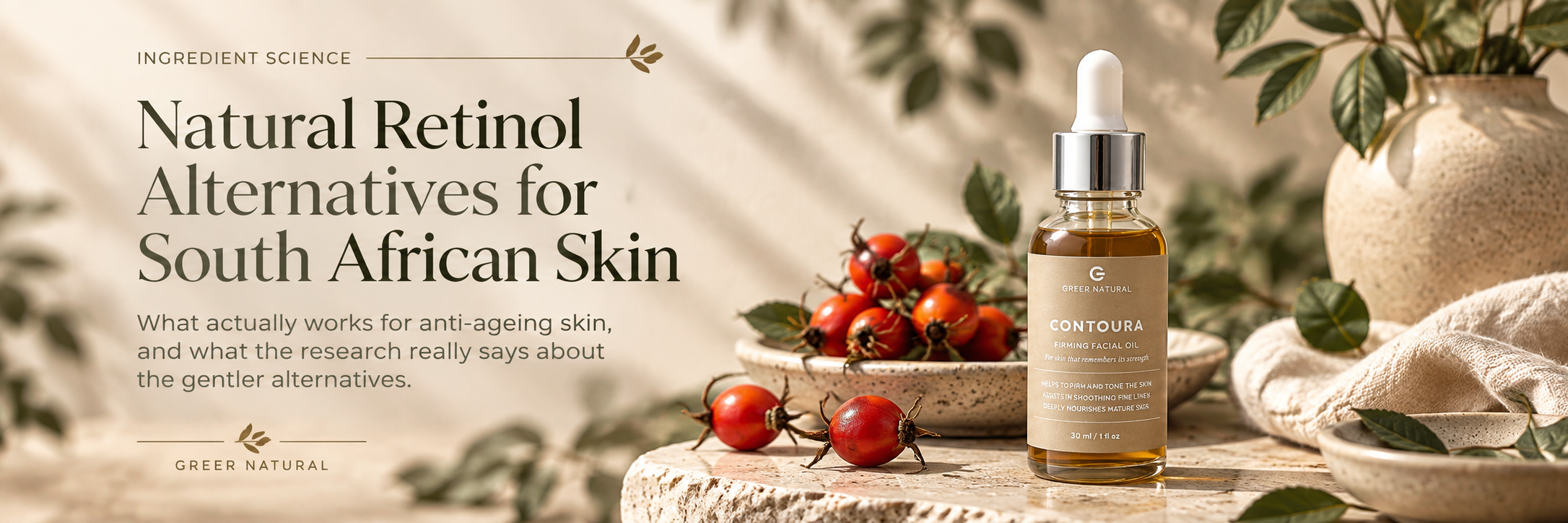
Contoura Firming Facial Oil contains a rosehip-forward formulation specifically designed for mature, ageing, or firmness-focused skin. The rosehip provides naturally occurring retinoic acid alongside linoleic acid for barrier support. It's rounded out with pomegranate, argan and grapeseed oils, frankincense, geranium and vitamin E, all chosen for their collagen-supporting, antioxidant and nourishing qualities.
It isn't a pharmaceutical, and it won't work as fast or as hard as prescription tretinoin. Used properly over six to twelve weeks, what it will do is improve texture, luminosity, fine lines and firmness, with none of the irritation, none of the peeling and none of the photosensitivity that makes retinol such an awkward recommendation for South African skin.
If you want bakuchiol in your routine specifically, look for a standalone serum to layer under your Greer oil. Plenty of natural and clean beauty retailers stock one, and they sit well over a plant-oil base. Bakuchiol's work at gene level, rosehip's natural retinoic acid and marula's collagen protection add up to a genuinely evidence-backed routine, and one that works with your skin rather than against it.

Rosehip-forward · 30ml
Contoura Firming Facial Oil
A luxurious natural facial oil made to hydrate and protect mature skin. Rosehip, pomegranate, argan and grapeseed, blended for elasticity, smoothness and vitality. Rich, and it still sinks in beautifully.
R 335.00
★★★★★ 4.9 (9 reviews)
Shop Contoura
Anti-ageing routine tip
Press Contoura into slightly damp skin in the evening, after cleansing, rather than rubbing it in. Follow with SPF in the morning. If you're adding a bakuchiol serum, put that on first, let it absorb, then layer the oil over the top to seal it in and look after your barrier. Twelve weeks of consistency will tell you far more than any single application.
The honest bottom line
Retinol works. If your skin tolerates it and your life accommodates the sun rules, it's still an excellent option with the deepest evidence base of any of them.
But for a lot of people, sensitive or reactive skin, anyone managing PIH risk, pregnant women, those of us living under high UV, and everyone who simply tried retinol and found it too harsh, the natural alternatives aren't a compromise. They're a credible, well-supported choice.
Bakuchiol has the trial data. Rosehip has the naturally occurring retinoic acid. Marula has the collagen-protective phytosterols. Together they work on the same biology retinol targets, more slowly, with a much better side-effect profile, in formulas your barrier and microbiome can live with rather than recover from.
That's a real difference, and it's finally getting the research attention it deserves.
Explore Contoura Firming Facial Oil and the full Greer Natural range, or get in touch if you'd like help working out which formula is right for where your skin is right now.
Further reading
- Prospective, randomised, double-blind assessment of topical bakuchiol and retinol for facial photoageing, Dhaliwal et al., British Journal of Dermatology, 2019
- Bakuchiol: a retinol-like functional compound revealed by gene expression profiling, Chaudhuri & Bojanowski, International Journal of Cosmetic Science, 2014
- How Your Gut Health Shows Up on Your Skin, Greer Natural Skincare Guide
- Which Facial Oil Is Right for Your Skin Type?, Greer Natural Skincare Guide
- Why You Should Transition to Natural Skincare, Greer Natural Skincare Guide